
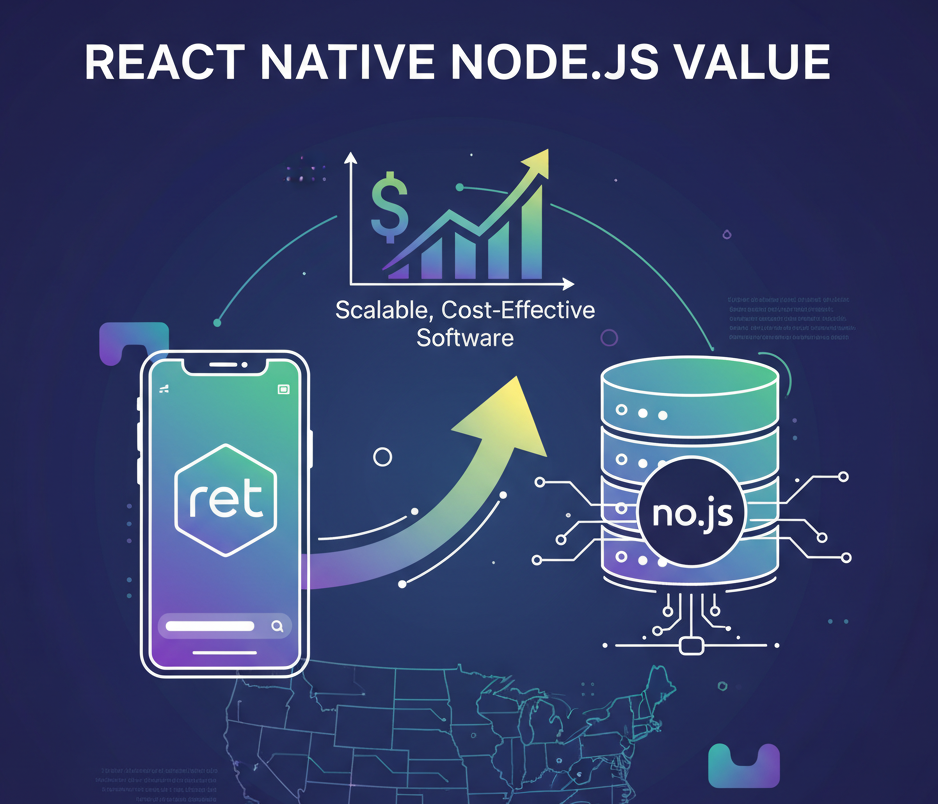
The React Native Node.js Development Value: Building Scalable, Cost-Effective Software for the USA Market
The Era of the Efficient MVP
The American tech landscape is more competitive than ever. Whether you’re a high-growth startup or an established enterprise undergoing digital transformation, the pressure is on: launch fast, iterate quickly, and scale without bankrupting the budget.
In this environment, the “full-stack JavaScript” pairing of React Native and React has become the definitive choice for modern app development in the USA. This powerhouse combination isn’t just about using trendy technology; it’s about maximizing efficiency to deliver measurable business value. This article explores the precise value proposition of this unified architecture and why its demand continues to surge across sectors.
The Unified Power of Full-Stack JavaScript
The core value of this stack lies in using a single language—JavaScript—for every layer of the application, from the server (Node.js) to the mobile user interface (React Native).
- Shared Talent Pool: Instead of hiring separate teams for native iOS, native Android, and a separate back-end language (like Python or Java), you can leverage a single talent pool of JavaScript developers. This significantly reduces your cross-platform mobile development cost and simplifies hiring.
- Code Reusability: React Native allows developers to share up to 90% of a mobile app’s codebase between iOS and Android. Node.js complements this by often allowing business logic to be shared between the server and the app. This drastically speeds up development and maintenance cycles.
Cost-Efficiency: The Startup MVP Dream
For a startup looking to validate a concept, time and money are critical. The RN/Node stack is perfectly tailored for building a Node.js for startup MVP (Minimum Viable Product).
By accelerating the initial build and reducing the required team size, you lower the overall burn rate. You get a functional, native-feeling app on both major platforms with a high-performance back-end for the cost of what might otherwise only cover a single native platform. This cost-effective entry point allows companies to save capital for post-launch marketing and scaling.
Speed and Time-to-Market (TTM)
In the highly saturated modern app development USA market, TTM is often the difference between market leadership and obsolescence.
The speed advantage comes from two main areas:
- Faster Development Cycles: React Native’s “Hot Reloading” feature allows developers to see code changes instantly, which is a massive productivity boost.
- Pre-Built Ecosystem: Node.js’s vast npm package repository and React Native’s component-based structure mean developers rarely have to “reinvent the wheel,” relying on mature, open-source modules to accelerate feature delivery.
RN/Node Scalability for Hyper-Growth
A common misconception is that JavaScript is slow. In reality, Node.js is built on the lightning-fast V8 JavaScript engine (developed by Google for Chrome) and uses a non-blocking, event-driven architecture. This makes it exceptionally performant for handling large volumes of concurrent connections—perfect for modern, real-time applications like FinTech or e-commerce platforms.
Furthermore, its microservices-friendly architecture allows you to easily break down the application into smaller, manageable services that can scale independently, ensuring your platform can handle a surge in users without requiring a full system overhaul.
Conclusion: The Future-Proof Stack
The React Native Node.js development value is clear: it offers a rare balance of speed, cost-efficiency, and robust RN/Node scalability. This is why the stack powers giants like Walmart, Uber, and PayPal. By choosing full-stack JavaScript, businesses like yours are not just selecting technology; they are choosing a smarter, faster path to digital success in the competitive American tech industry.
powered by SRTech
good blog